
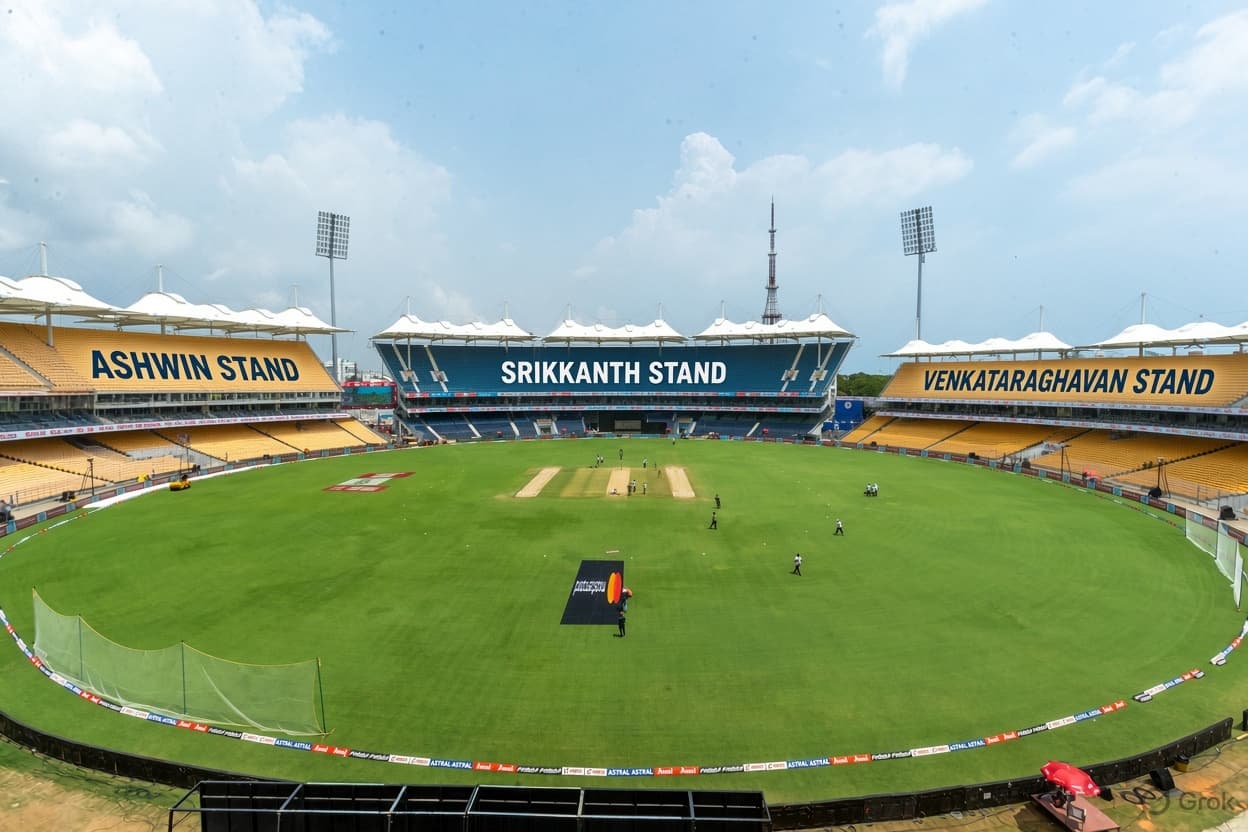
Ashwin, Srikkanth, Venkataraghavan to have their own stands in Chepauk stadium
Three proposed stand names connect Chepauk’s future to Tamil Nadu’s contribution across generations.
 By Thiyag
CricBubble’s existing editorial illustration.
A stadium’s history is often told through the matches played there. Stand names offer another route into the story: they ask people arriving for a new contest to remember those who helped shape the game before them. At Chepauk, the planned recognition of Ravichandran Ashwin, Krishnamachari Srikkanth and Srinivasaraghavan Venkataraghavan can connect the excitement of a match day with a much longer local memory.
The New Indian Express reported on 29 September that the Tamil Nadu Cricket Association had decided at its annual general meeting to name three stands after the former India players. The report said the unveiling was expected before the Big Bash opener at the M.A. Chidambaram Stadium on 12 December. The distinction matters: this is a reported plan for an honour, not confirmation that the ceremony has already happened.
Three careers, rather than one model of greatness
Ashwin’s record gives the contemporary audience an immediate point of recognition: 537 Test wickets and a place among India’s most accomplished bowlers. For younger supporters who followed his international career, his name can make the connection between televised achievement and a familiar Chennai ground unusually direct. It is a reminder that cricketing ideas developed locally can become part of the global game.
Chepauk’s planned honours
- ◆Reported honourees: R. Ashwin, K. Srikkanth and S. Venkataraghavan.
- ◆Venue: M.A. Chidambaram Stadium, Chennai.
- ◆Decision reported after the TNCA annual general meeting in September 2026.
- ◆Unveiling expected before the 12 December BBL opener, according to the report.
- ◆The supplied stand-name visual is illustrative; exact completed signage is not verified.
Srikkanth offers a different reference point. A member of India’s 1983 World Cup-winning team, he later chaired the selection committee when India won the tournament again in 2011. His recognition can therefore introduce conversations about both playing and selection. A cricketing life may influence more than one generation, and its significance need not end with the final appearance as a player.
Venkataraghavan and the value of a longer memory
Venkataraghavan captained India at the 1975 and 1979 World Cups and belonged to the celebrated spin quartet. His later work included umpiring and administration. For a new spectator, those roles may require more explanation than a recent wicket-taking record. That is precisely why keeping the name visible matters: the ground can preserve a story that current highlights alone are unlikely to tell.
Together, the three names resist the idea that sporting achievement comes in only one form. A wicket-taker, an attacking opening batter and a player whose service extended into officiating can all belong in the same landscape of recognition. The interest lies in their differences as well as their shared connection to Tamil Nadu. The honour becomes richer when those differences are explained rather than compressed into a generic label of legend.
Why a stand name can be more than a tribute
Unlike a one-off presentation, a stand becomes part of everyday speech. Supporters mention it while arranging where to meet, describing their seats or remembering an afternoon at the ground. The name enters the ordinary experience of attending cricket. That repeated use can give a tribute a longer life than an anniversary speech, provided the people using it are also given a way to understand whom it honours.
There is an opportunity here for simple, accessible storytelling. A short biography near an entrance, an account of a defining contribution or a well-designed historical display can turn a name into a person. For a child attending a first match, one clear story may be more useful than a wall of numbers. Recognition works best when it opens a door to curiosity rather than assuming that every spectator already knows the past.
A local identity in an increasingly global calendar
The expected timing before the BBL opener creates an interesting pairing. Chepauk would be welcoming an Australian league while drawing attention to Tamil Nadu’s own cricketing inheritance. Those ideas need not compete. An international event can introduce visitors to the ground’s identity, while the names around the playing field remind everyone that the venue had a life before the current fixture and will have one afterwards.
For CricBubble, that is the strongest argument for the honour. A stadium should be able to host new competitions without becoming interchangeable scenery. Its setting, audience and memory are part of what makes it worth visiting. Naming stands after cricketers can help retain that character, especially when the choice recognises sustained service across eras rather than only the most recent moment of fame.
The next step is to make the history easy to find
A naming announcement is the beginning of a public tribute, not its entire achievement. What matters afterwards is whether the stories are presented accurately and made accessible to people moving through the ground. The experience should welcome supporters who know the careers intimately and those encountering the names for the first time. A tribute does not lose seriousness by being easy to understand.
The planned Ashwin, Srikkanth and Venkataraghavan stands offer that possibility: three entry points into how Tamil Nadu has contributed to Indian cricket. The scoreboard will keep moving on to the next match and the next season. The names can provide continuity around it. Done thoughtfully, the honour will give spectators more than a new direction to their seats; it will give them another reason to look around.
Enjoyed this CricBubble take?