
Cricket World Cup 2027 schedule
India open against Australia on 7 October — the groups, new format and route to the final explained.
 By Thiyag
World Cup trophy illustration from CricBubble’s existing article artwork.
A World Cup schedule is more than a collection of dates. It tells supporters where the big confrontations will happen, how teams must pace their campaigns and which early results could shape the weeks that follow. For 2027, the headline is immediately attractive: India and Australia begin their group campaigns against each other, while a meeting between India and Pakistan follows just three days later.
The ICC announced the fixtures on 1 October 2026. South Africa, Zimbabwe and Namibia will jointly stage the tournament from 2 October to 21 November 2027, with 14 participating teams, 57 matches and 12 venues. But the first date needs explaining: the competition starts with a preliminary Super Series, not with the India–Australia fixture. Understanding that distinction makes the rest of the schedule much easier to follow.
The dates to put in your diary
World Cup 2027: key dates
- ◆2–6 October: the opening Super Series in Namibia.
- ◆7 October: India vs Australia, Newlands, Cape Town — the group stage begins.
- ◆10 October: India vs Pakistan, Wanderers, Johannesburg.
- ◆25 October–14 November: the Super 7 phase.
- ◆17 November: first semi-final, Cape Town; 18 November: second semi-final, Tshwane/Centurion.
- ◆21 November: the final, Johannesburg.
For India, that opening pair of games offers little time to settle into the tournament. Australia provide an immediate test, and Pakistan bring another demanding contest before the campaign is a week old. The practical challenge is to arrive ready to compete, rather than rely on the opening fixtures to discover the right balance. A schedule can offer breathing space; this one asks for early clarity.
The groups: familiar rivals, limited room for drift
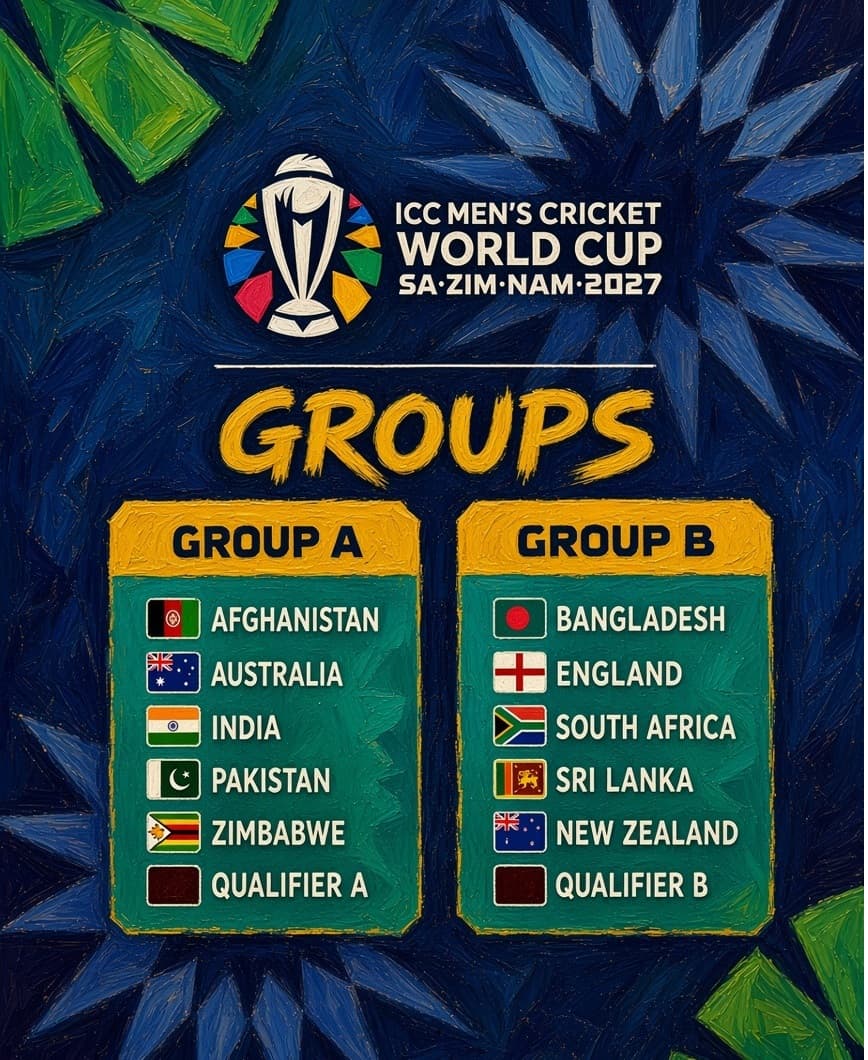
Group A contains Afghanistan, Australia, India, Pakistan, Zimbabwe and Qualifier A. Group B contains Bangladesh, England, New Zealand, South Africa, Sri Lanka and Qualifier B. Each side plays the other five teams in its group once. Those qualifier labels are placeholders, so the graphic should be read as the announced group structure rather than a final list of every participating nation.
It would be easy to reduce Group A to its most marketable matches. That would miss the competitive problem. A five-game group campaign rewards consistency across the entire schedule, not simply a strong performance against a traditional rival. For a contender, the less celebrated fixture still carries the same basic demand: turn preparation into points. Reputation does not provide protection against an awkward afternoon.
Fourteen participants, twelve group-stage teams: why both are correct
The format begins with three teams in a round-robin Super Series. Only its winner advances. That team joins ten direct entrants and the winner of the preceding World Cup Qualifier to complete the twelve-team group stage. The tournament therefore has fourteen participants overall, even though the two main groups contain six teams each. The early phase is part of the World Cup, not a warm-up event.
From the groups, the top three in each section and the better fourth-placed side progress to a seven-team round robin. Group-stage points are not carried into that Super 7 phase. Each survivor faces six opponents, and the top four then enter the semi-finals. Pre-seeded fixture positions help describe possible routes, but they do not guarantee qualification: teams still have to earn their place.
The cricketing test behind the format
For supporters, the attraction is a campaign with several different pressures. First comes the need to qualify; then comes the need to establish a strong position in a new table. A team cannot simply preserve an early advantage through the entire tournament. Equally, a difficult group performance need not define every later result once the next stage starts. The ability to reset becomes part of the challenge.
For selectors and captains, that makes squad depth more than an insurance policy. A tournament running across several weeks asks teams to maintain standards while changing opponents and moving between venues. The strongest squad on paper still needs clear roles, credible alternatives and players who can adjust. CricBubble’s view is that the schedule rewards a well-organised team as much as an impressive first-choice eleven.
Three hosts, one campaign to navigate
The event spreads beyond one national centre of gravity. Namibia hosts the opening phase in Windhoek, Zimbabwe contributes venues including Victoria Falls, and South Africa stages the knockout finish. For the audience, that geographical range is part of the tournament’s identity. For the teams, every move is another transition to handle: preparation must travel as well as the players do.
Fans planning to attend should work from the ICC’s official fixture and ticket pages, checking the latest allocations before making bookings. A likely Super 7 match-up remains conditional until its teams qualify. That is the important balance when reading the schedule: enjoy the possibilities, but keep the difference between a confirmed fixture slot and a confirmed opponent in mind. The road to Johannesburg is mapped out; who travels it is still cricket’s business.
Enjoyed this CricBubble take?